

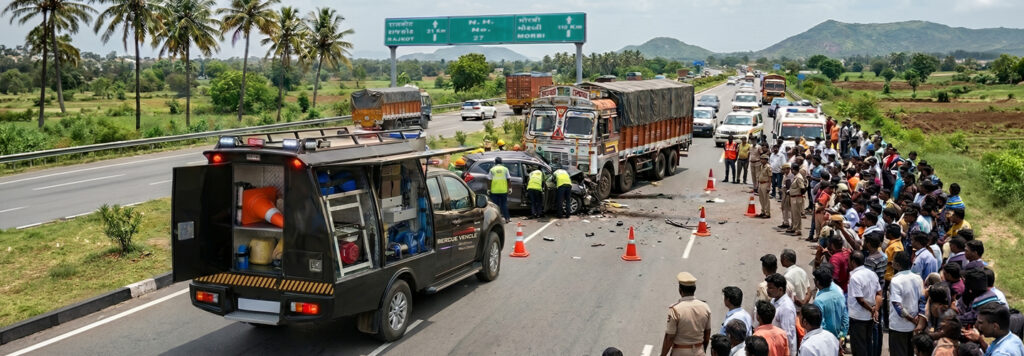
A highway accident changes everything within seconds.
One moment, traffic is moving normally. Next, vehicles stop, people gather around, confused, and someone is waiting for help to arrive. On busy Indian highways, these situations are becoming more common with increasing traffic movement, long-distance transportation, and expanding expressway networks.
This is where Traffic Rescue Vehicles are quietly becoming one of the most important parts of highway safety.
They are not just emergency vans parked for formality. These vehicles are designed to reach accident spots quickly, support rescue teams on the ground, clear blocked roads, and help injured people, before delays make the situation worse.
For highways where every minute matters, having the right response vehicle nearby can make a real difference.
Most highway accidents are not simple situations.
A truck overturns in the middle lane. A vehicle gets badly damaged after a collision. Traffic starts piling up from both sides. People try to help, but there is confusion, panic, and very little coordination.
In these moments, normal roadside support is usually not enough.
A dedicated Highway Rescue Vehicle is built specifically for these kinds of situations. It carries rescue equipment, safety systems, emergency lighting, recovery tools, and operational support needed during highway emergencies.
Instead of waiting for different teams and equipment to arrive separately, responders can begin work immediately from a single vehicle.
That speed matters more than most people realise.
One of the biggest challenges during highway accidents is response time.
Even when emergency teams are informed quickly, reaching the exact location is not always easy. Traffic congestion, poor visibility at night, and long highway stretches often delay assistance.
A properly equipped Highway Emergency Vehicle helps reduce this delay. These vehicles are designed for quick movement on expressways and can operate efficiently in difficult roadside conditions.
As First Responder Vehicles for Expressways, they help emergency personnel reach accident locations with the tools they already need on board.
Sometimes, a faster response is the difference between controlled rescue and complete chaos.
Not every accident can be handled with basic roadside assistance.
There are situations where passengers get trapped inside damaged vehicles or where recovery becomes difficult because of heavy impact. In such cases, rescue teams need proper equipment and enough working space to operate safely.
A modern Road Accident Rescue Vehicle is usually fitted with systems that support these operations, including:
These setups help responders work faster without creating additional risk for victims or nearby traffic.
More importantly, they help bring some structure into situations that are otherwise extremely stressful.
One accident on a highway can quickly turn into a much bigger problem.
When damaged vehicles block lanes and visibility reduces, the risk of secondary accidents increases immediately. Drivers approaching the scene often panic or brake suddenly, especially during nighttime or heavy traffic hours.
This is why a Rescue Vehicle for Highway Accidents is not only important for victims but also for overall traffic safety.
Warning lights, reflective systems, barricading tools, and traffic guidance equipment help create a safer working zone around the accident area. This allows emergency teams to do their job while reducing danger for other motorists on the road.
In many highway situations, controlling the scene properly is just as important as the rescue itself.
During emergencies, there is very little room for failure.
Every equipment compartment, every lighting system, every recovery tool, and every An operational feature inside the vehicle needs to work properly under pressure.
That is why DHI Mobility plays such an important role in building a reliable emergency response systems.
These vehicles are designed keeping actual field conditions in mind, long operational hours, rough road environments, emergency handling requirements, and responder safety.
For government agencies, highway operators, and industrial sectors, investing in dependable rescue systems is not only about infrastructure. It is about being prepared and DHI Mobility’s Traffic Rescue Vehicle is ticking all these boxes and is mission ready.
India’s highways are growing rapidly, and with that growth comes greater responsibility.
Better roads alone cannot prevent every accident. But a better emergency response can reduce the damage that follows.
A dependable Emergency Rescue Vehicle helps emergency teams act faster, work safer, and manage difficult situations more effectively when time is critical.
And sometimes, that timely response is what brings someone home safely.
Because highway safety is not only about movement.
It is also about being ready when something goes wrong.